
A Ring
Listening again to George Herbert's "Hope"

This advice will be familiar to any close reader: mind the details, pay attention to your own surprise and confusion. To wake ourselves up to these possibilities, we rely on a few strategies. For example, reading the poem with a friend and talking about it […] Even reading the poem aloud to yourself is useful: you will likely notice many choices when you hear how the poem sounds
Jeff Dolven and Joshua Kotin, “The Poet’s Choices: Helen Vendler on John Keats”, in Close-Reading for the Twenty-First Century (2025), ed. Dan Sinykin and Johanna Winant
This week, I had the chance to go back to a short poem that I once often taught with students, and had the happy experience of finding it was still as inexhaustible as I felt it to be then. The occasion was a session with high-school teachers on practical techniques for reading poetry in the classroom. I chose the poem as our warm-up, because I realised that, in eight lines, it prompted all the questions that, over the years, I have developed to start discussion about poetic form and meaning. And once again, by discussing it with others, I discovered something I had never noticed before.
The poem is “Hope” by George Herbert, from his great work of Christian devotional poetry, The Temple (1633):
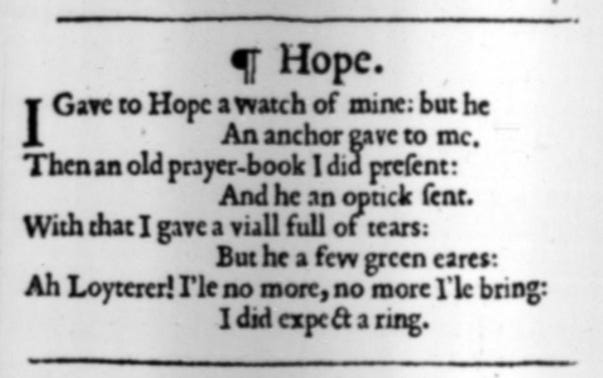
It does not take long to say, in general terms, what this poem is about, and even what it means. The title tells us that it is concerned with the virtue of hope, and the first line establishes how this abstraction will be made allegorically concrete: Hope is personified (like God in other poems of The Temple) as a powerful man with whom the first-person speaker bargains. But the bargaining becomes an argument, because the speaker’s gifts to Hope are asymmetrically reciprocated. A “watch”, a portable timepiece, is rewarded with an “anchor”, the opposite of a portable thing; “an old prayer-book”, much read, is swapped for an “optic”, a magnifying lens or telescope (the latter sense is how John Donne uses it, describing astronomers); and, most incongruously of all, a “vial full of tears” — the distilled proof of hours of suffering — buys a handful of unripe corn, “a few green ears”. The speaker, it seems, is being taught a lesson that he does not yet understand, about hope as a virtue in itself, as distinct from expectation. His gifts represent earthly time spent expecting heavenly reward — the eternity symbolised by the token of a ring. But all of Hope’s gifts return him to earth and time. The speaker has made a mistake: Hope does not give the relief of certainty even to the faithful; he only offers them the means to keep hoping.
It’s not a bad moral to offer students in the first week of a three-year degree, which is what I was doing when I first taught the poem. But the main reason I chose the poem as an introduction to the academic practice of “close reading” is that its overall meaning still allows many subtleties of interpretation. “Hope” is what is known as an “emblem poem”, a genre that emerged from the early modern popularity of emblem books, in which abstractions were depicted as symbolic figures, alongside text drawing out a moral. Here, for example, from Geoffrey Whitney’s A Choice of Emblems (1586) is “Illicitum non sperandum” (“Do not hope for what is not allowed”), illustrated by picture and rhyming couplet: “Here Nemesis and Hope our deeds do rightly try, / Which warns us not to hope for that which justice doth deny”.
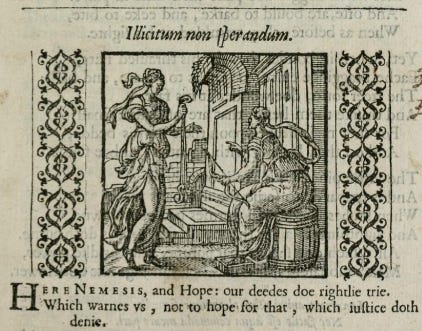
Herbert’s emblem poem, however, is more riddling picture than explanatory rhyme, leaving us to puzzle out the metaphorical implications of its images (are the “few green ears” of corn, for example, offered as something the “vial of tears” might usefully water?). In this way, “Hope” neatly exemplifies T.S. Eliot’s observation that
The chief use of the “meaning” of a poem, in the ordinary sense, may be [...] to satisfy one habit of the reader, to keep his mind diverted and quiet, while the poem does its work upon him: much as the imaginary burglar is always provided with a bit of nice meat for the house-dog.
I like Eliot’s critical metaphor because its implication, under its comic-book surface, is profound. If the meaning of a poem is the bit of meat that keeps the dog of the mind quiet, then the “work” of the poem is analogous to what a burglar does: gets through our locked doors and takes away the things we thought were ours. The meat of meaning is the bait that leaves the cupboard bare, and the real “work” of the poem, which robs us of our certainties, is done by other means: its form, its sound, its music.
And this is, again, why I’ve always found “Hope” such an exemplary poem to explore with students. Its form — like its story of things exchanged — is ostensibly simple: rhyming couplets comprising a long and a short line (iambic pentameter/iambic trimeter), which perform the repeated conflict of eager offering and cryptic response. Every line, though, is subtly different in rhythm, as Herbert dramatises the speaker’s frustration. The balanced, monosyllabic iambic pentameter of line 1, for example,
