
That Vase
Thinking about what "that" can do in a poem

A little while ago, I was talking with a friend who is a writer about (what else?) the difference between restrictive and non-restrictive clauses. American editors in particular tend to be sticklers for the style rule that “that” introduces a restrictive clause — the kind that has an essential identifying function — while “which” introduces a non-restrictive clause, which gives additional information. In the sentence I have just written, for example, there is a restrictive clause (“that has an essential identifying function”) and a non-restrictive clause (“which gives additional information”). In British English, however, “which” is often used for restrictive clauses too e.g. “the kind which has an essential identifying function”.
Trying to get our heads around this distinction as clausally chaotic British writers, I suggested that William Carlos Williams’ poem “This Just to Say” illustrates it nicely:
I have eaten
the plums
that were in
the iceboxand which
you were probably
saving
for breakfastForgive me
they were delicious
so sweet
and so cold
My argument went like this: it is essential identifying information about the plums that they were in the icebox, but their status as something saved-for-breakfast is additional information — and the whole miniature drama of the poem turns on this distinction: the speaker disingenuously pretends the plums’ essentially restricted nature was open to doubt (“and which / you were probably / saving”). My friend wasn’t entirely convinced though, arguing that both clauses could be “that” or “which”.
Perhaps there is no hope for British writers. But our discussion left me feeling that, somehow, it wouldn’t be the same poem if they were the plums “which were in / the icebox”. “That” has some other force here which is more than grammatical: a sort of insistence, felt in the mouth, that attests to the speaker’s satisfaction with the plums, even before it is explicitly declared. Sonically, “that” assonates with “have”, while also making an alliterative trio of “th” sounds down the left margin. All of which embeds it as necessary sound. For this speaker, it was not optional information “that” the plums were in the icebox: their coldness was their sweetness and their beauty.
Can so much be made poetically of one of the most functional syllables in English? Can it really be a keystone bearing the emotional weight of a poem? These are questions I asked myself more than once as I thought about this post. But here goes.
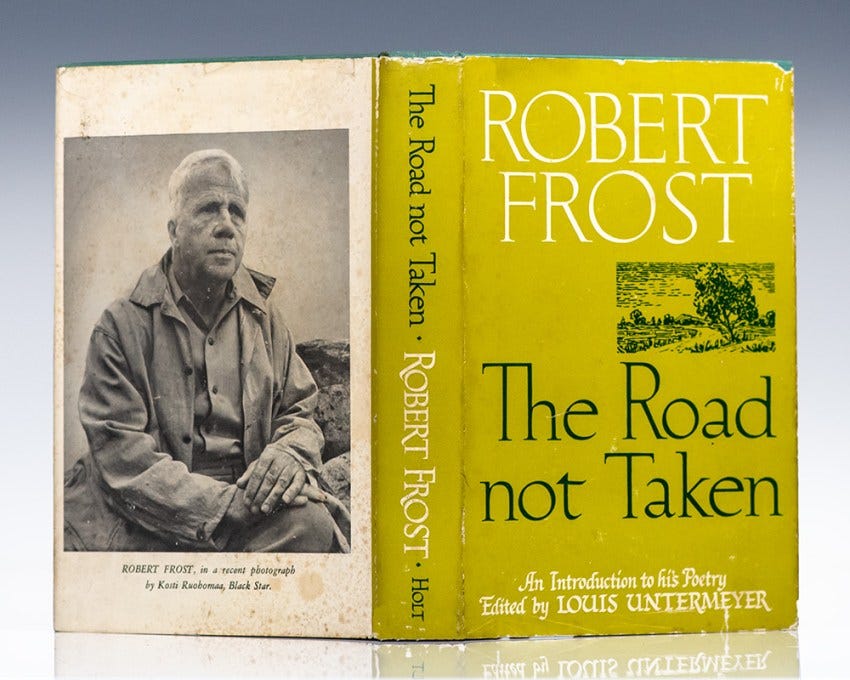
Perhaps the most famous “that” in modern poetry occurs in Robert Frost’s “The Road Not Taken”:
Two roads diverged in a yellow wood,
And sorry I could not travel both
And be one traveller, long I stood
And looked down one as far as I could
To where it bent in the undergrowth;Then took the other, as just as fair,
And having perhaps the better claim,
Because it was grassy and wanted wear;
Though as for that the passing there
Had worn them really about the same,And both that morning equally lay
In leaves no step had trodden black.
Oh, I kept the first for another day!
Yet knowing how way leads on to way,
I doubted if I should ever come back.I shall be telling this with a sigh
Somewhere ages and ages hence:
Two roads diverged in a wood, and I—
I took the one less travelled by,
And that has made all the difference.
It is hard to read this poem all the way through without falling heavily on the “that” in the final line. It is not a relative pronoun introducing a restrictive clause, but what the OED calls a “demonstrative pronoun with singular agreement”: that is,
The thing or person pointed out or present, or that has just been mentioned
This pointing sense — which linguists call “deixis” — is the primary meaning of “that” for English speakers: the sense it can make as a word on its own, accompanied by a gesture. It comes at the end of the poem with a decisiveness that sounds final, evoking the moment of choice (“Let’s take that one”) which Frost’s friend, the poet Edward Thomas, reportedly found so hard when they were out walking in the English countryside. But as Frost himself was fond of pointing out, the poem is “tricky”: having taken the one path, how can the speaker know the “difference” between it and the other — between the choice of this or that? The poem begins with the impossible wish to “travel both / And be one traveller”. The limiting word “that” only enters once the choice has been made in the second stanza, and the speaker immediately starts to doubt the grounds of the decision, looking back to a scene that is past:
Though as for that the passing there
Had worn them really about the same,And both that morning equally lay
In leaves no step had trodden black.
“That”, in other words, marks the point where the thought-path of the poem forks into infinite doubt: the speaker can never go back to that “that”, that split second of decisiveness. It is an irony dramatised in the final stanza by another doubling:
Two roads diverged in a wood, and I—
I took the one less travelled by
Having once wished to be “one traveller”, the speaker is still haunted by the sense of being two, as heard in the hesitation and repetition of self across the linebreak (“I— / I”). And if we hear this, then we also hear the hollowness that the last line amplifies as its sighing explanation of a life falls inarticulately into a final emphatic “that”.
