
The Wood Rings
On Sylvia Plath's "Words"

This week saw the publication of The Poems of Sylvia Plath, a comprehensive scholarly edition which does an excellent job of presenting her work on its own terms, beyond the long shadow of her life and death. As I wrote in my review for Prospect magazine:
W.H. Auden thought it a bad sign if a young person wanted to write poetry because they had “something important to say”; instead, the promising poet is the one who likes “to hang around words and overhear them talking to one another”. Increasingly, Plath did have something important to say: about her experience of the treatment of mental illness, and about her life as an ambitious and passionate woman in a misogynist world. But she was also a lifelong word collector.
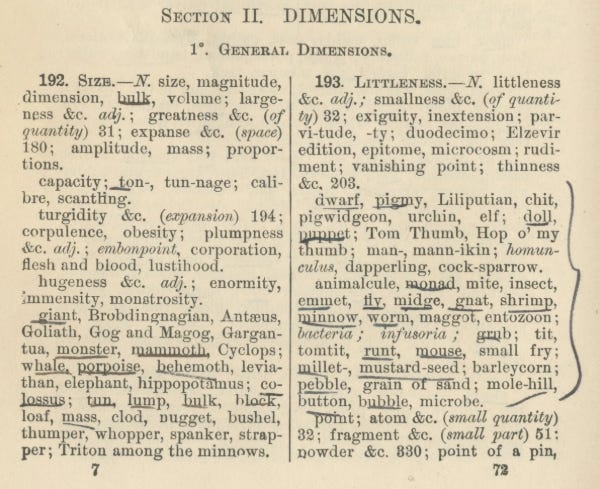
Among her last poems was one called “Words”. It expressed Auden’s idea that words have their own lives as “Echoes traveling / Off from the center like horses”. One of the most fascinating gifts of this meticulous edition to readers of Plath comes from the editors’ combing-through of her copy of Webster’s Collegiate Dictionary for underlined definitions of words that appear in her poems. Another “oo” rhyme in “Daddy”, “gobbledygoo”, for instance, was her own nursery-rhyme variation on Webster’s “gobbledygook”: “inflated, involved, and obscure verbiage characteristic of pronouncements of officialdom”.
The sentences here about Plath’s poem “Words” were cut from the final edit, but I’ve continued to think about what it means to think of words as if they were alive.
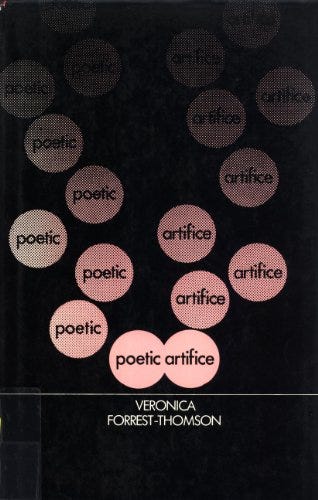
The single most acute critical discussion of Plath’s work that I know is to be found at the end of a book called Poetic Artifice: A Theory of Twentieth-Century Poetry (1978), by the poet and critic Veronica Forrest-Thomson. The argument of Poetic Artifice focuses on the modernist tradition of Ezra Pound and T.S. Eliot; its many insights and subtleties might be summarised as an attempt to develop a technical explanation of Eliot’s idea of “impersonality” in poetry, as proposed by his essay “Tradition and the Individual Talent”. Central to this is Forrest-Thomson’s distinction between “good” and “bad” Naturalisation in the critical discussion of poems. Bad Naturalisation reaches around the text for facts from the external world to explain it (e.g. Sylvia Plath’s death by suicide). Good Naturalisation, however, attends to the internal world of the poem, and how its images and sounds speak to each other of their own poetic reality, much as Auden suggested words can be overheard “talking to each other”.
As Forrest-Thomson’s argument reaches its conclusion, she holds up poems by Auden, J.H. Prynne and John Ashbery as examples of verse in the modernist tradition that invites and repays good Naturalisation, but takes a sideswipe at Plath’s husband, Ted Hughes, as a poet working “entirely in complicity with bad Naturalisation” through poems that try to communicate a predetermined message for interpretation. Forrest-Thomson then takes another dig at Hughes as a critic who encouraged the bad Naturalisation of Plath, with comments implying “that the women who suffers cannot relieve her suffering by becoming the mind which creates”. This formulation is one of Forrest-Thomson’s many echoes of Eliot’s claims about “impersonality”:
The more perfect the artist, the more completely separate in him will be the man who suffers and the mind which creates
(“Tradition and the Individual Talent”)
Forrest-Thomson’s point is that biographical readings of Plath deny the poet the artistic “perfection” of reading her work on its own terms — that is, in its own words. To illustrate this, Forrest-Thomson imagines a bad critical Naturalisation of Plath’s poem “Purdah” (“The poet identifies herself with a woman in purdah, therefore she feels stifled”) and then shows how such a literal-minded reading would fail to account for the sheer unnerving strangeness of the poem’s last lines:
The lionness,
The shriek in the bath,
The cloak of holes.
Forrest-Thomson writes:
What can that last phrase mean except just what it says? I think we should all be agreed that a cloak of holes does sound rather terrifying, but why? Because it is a contradiction in terms; a cloak cannot be made of holes.
And yet — partly due to the compelling vowel music that Forrest-Thomson elsewhere calls the “key of o” — we accept this logical contradiction as a meaningful poetic image.
It’s a way of reading which can, I think, illuminate how Plath’s poems actually work on us in ways that can be missed by readings led by biographical narrative. “Words”, for example, was among the last six poems she wrote in early February 1963, before her suicide later that month. But it is often only mentioned in passing in overview accounts of her work — badly Naturalised as a poem in which “the poet reflects on her medium” — because the biographical nature of other poems is more obvious. Let’s pretend we don’t know any of that though, and take just the first stanza:
Words
Axes
After whose stroke the wood rings,
And the echoes!
Echoes traveling
Off from the center like horses.
The abruptness of the single-word first line invites us to read it in apposition to the title (“Words, axes”), as if the blank line in between marked the threshold of metaphor. Beginning this way, though, makes for a syntactically awkward second line, which a simple revision could have smoothed by removing the possessive pronoun “whose”:
After the stroke of axes
The wood rings
We are thus immediately warned that the poem intends to place individual words in a particular order that paraphrase might smooth over. And the deliberately snagging syntax continues in the next line, which extends but doesn’t perfectly continue the sense of the second: “And the echoes!”. The exclamation itself echoes out of the previous clause (“the wood rings”), without its own verb. The general sense it makes is to name the acoustic afterlife of what happens when the axe strokes and the wood rings. Rhetorically, however, it is an example of both anacoluthon — when a speaker changes the grammatical construction of what they are saying mid-sentence — and aposiopesis, when a speaker breaks off from what they were saying to leave it hanging.
Both these rhetorical devices are common in Shakespeare — which is another way of saying there is a lot of drama in the way this first sentence is constructed, presenting not just a metaphor (“Words are the strokes of axes that make the wood ring with echoes”) but a thought process in which what the words are doing is felt as it happens. And with every word added, the effect becomes more complex. The next Shakespearean device we encounter is anadiplosis: the repetition of the last word of a line or sentence at the start of the next. Aptly enough, this is “echoes! / Echoes”. And it starts us on a new metaphor: “traveling / Off from the center like horses” — an image which, like a fading echo, travels further from the centre of the previous image.
So a complete paraphrase of the stanza might be: “Words are the strokes of axes that make the wood ring with echoes travelling off from the centre like horses”. Not only does this flatten the drama of the thinking voice, though; it dampens the echoes that are internal to how the words are arranged as verse. To go back to the beginning: “Axes” — set all on its own at the top like a tuning fork — establishes a set of sounds that return partly in “echoes” and partly in “horses”. Each is a line-end word, which almost gives the stanza a rhyme scheme, especially once we notice the quieter end-word chime between “ring” and “travelling” (the rhyme scheme would be ababa).
Placing “Axes” on its own, though — like a high-scoring Scrabble word — establishes something else about how to read this poem: the possibility that we might pause over any individual word and the echoes it sends out beyond its place in the sentence. When we do, the grammatical play of singular and plural forms starts to become another source of strangeness. An alternative rewriting of the first two lines might be
After the stroke of an axe
The woods ring
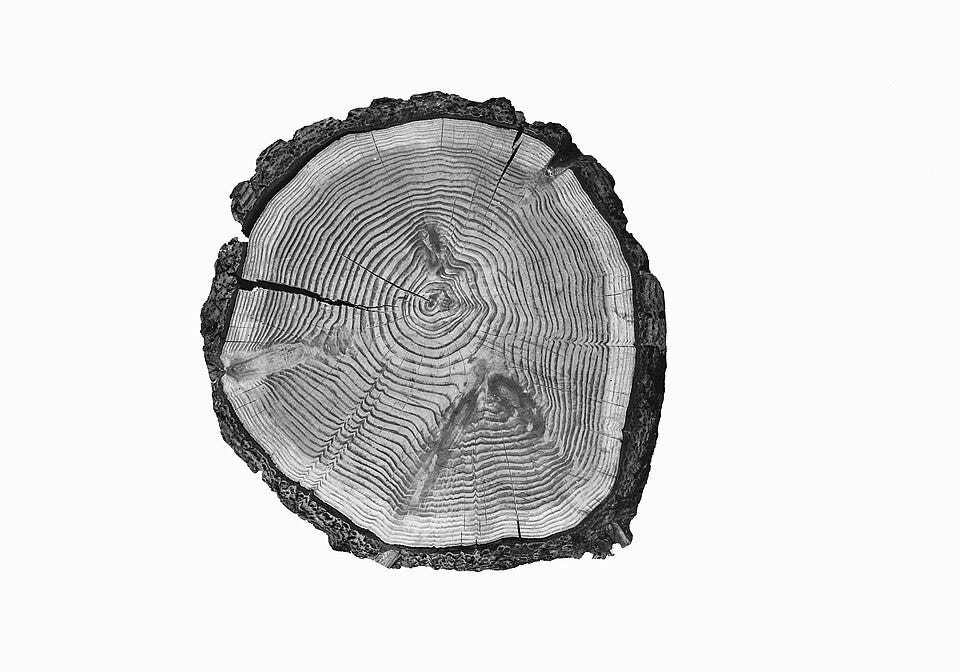
where to clarify the image I have swapped one “s” from “ring” to “wood”, and deleted another (“axe[s]”). But in doing so I’ve removed some hovering ambiguities that haunt the original phrasing if read in smaller units than the sentence: “Axes” on its own could be a verb; the phrase “whose stroke” could suggest a gentle, human touch; and “the wood rings” could be a way of naming what we see when an axe has felled a tree: its concentric growth rings.
Here’s the whole stanza again:
