
Dateless Night
On the darkness of Shakespeare's Sonnet 30

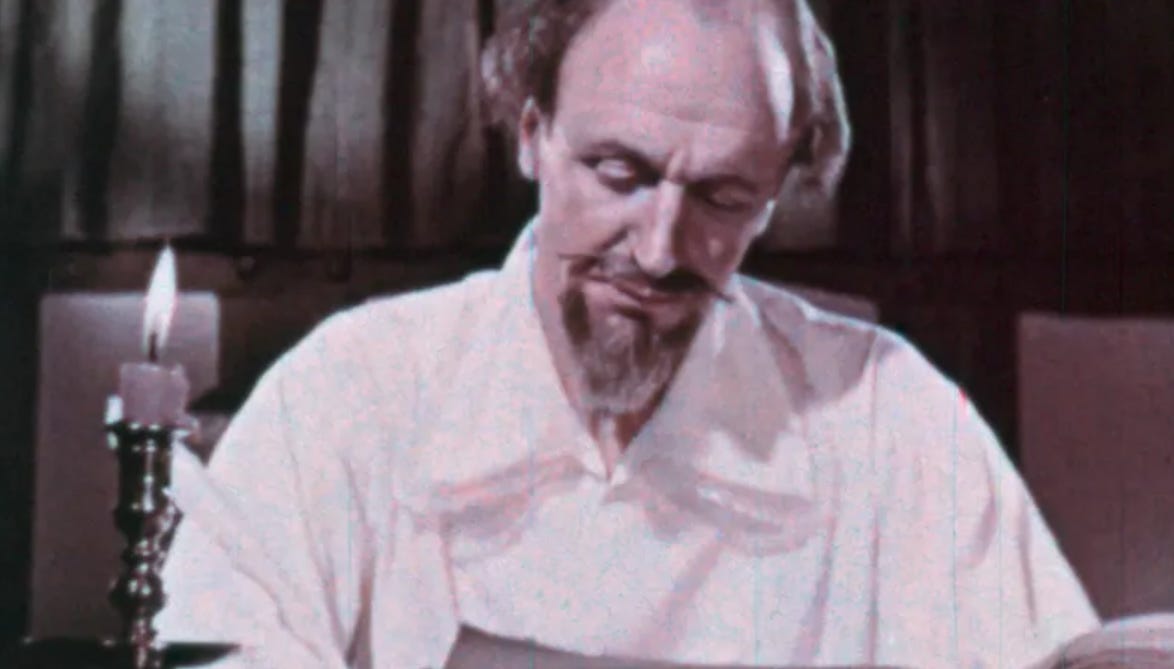
This week I had the pleasure of talking about a single Shakespearean sonnet for an hour with my friend, Joe Hedinger, who works at The Book Hive in Norwich, but is also an enthusiastic and inspirational tutor for people who want to learn how to read poetry. It was the first session in a series we are doing across July: next week, on Wordsworth, is sold out, but there are still tickets left for Hopkins, Bishop and Hayes if you are near enough to come along: https://www.thebookhive.co.uk/events/
I suggested a couple of Shakespeare’s sonnets that we might discuss, and Joe chose Sonnet 30 for its haunting and chilling quality: how it sounds like the thoughts of someone who has woken at 3 am, tortured with regret. It’s that characterisation that I want to think about more in this post — and specifically, the question of what we see and hear through the darkness of its fourteen lines (at the end, I will be comparing it to a modern sonnet that we know was composed in the dark night of a prison cell).
Here is Shakespeare’s poem:
When to the sessions of sweet silent thought
I summon up remembrance of things past,
I sigh the lack of many a thing I sought,
And with old woes new wail my dear time’s waste;
Then can I drown an eye (unused to flow)
For precious friends hid in death’s dateless night,
And weep afresh love’s long since cancelled woe,
And moan th’expense of many a vanished sight;
Then can I grieve at grievances foregone,
And heavily from woe to woe tell o’er
The sad account of fore-bemoanèd moan,
Which I new pay as if not paid before.
But if the while I think on thee (dear friend)
All losses are restored, and sorrows end.
As the couplet tells us, it is a poem about loss and sorrow and their hoped-for end. Hoped-for but not necessarily arrived-at, because I think it is hard to believe the brisk assertion of the consoling power of the “(dear friend)”, who is bracketed out of the poem in a way that seems still to mark an absence. A later poem in the sequence, Sonnet 126, ends unexpectedly at line 12, followed by two pairs of lunulae (curved brackets) outlining the space where we expect a couplet:
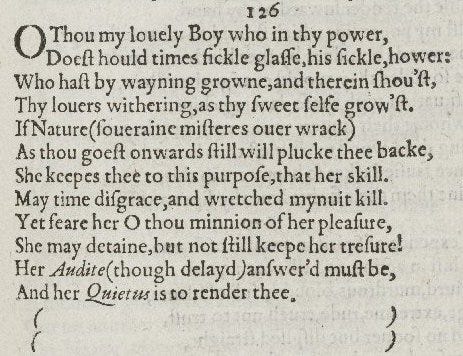
The theme of Sonnet 126 is the mortality of the “lovely Boy”, whom some of the sonnets have promised to immortalise in verse. The critic Stephen Guy-Bray reads the absent couplet as “Shakespeare’s tacit admission of his poetry’s impotence”. Similarly, the brackets in Sonnet 30 suggest quiet confessions of weakness: first of tears, as the speaker “drown[s] an eye (unused to flow)”, and then in the soft appeal to the friend.
The poem’s power, on the other hand, is to dramatise loss in a way that makes the reader experience it. I’ve written before, in relation to the poetry of Sir Thomas Wyatt, about how “obscurity” (from Latin obscurus: dark, shady, unknown) in early modern poetry might be understood as the representation of life without lightbulbs:
We are used to talking about imagery in poems, rarely how that imagery is lit. Yet lack of light is what is metaphorically implied when we speak of poetry as “obscure”. We use the metaphor as a way of expressing the unclear meaning of words. What, though, if we also thought about the darkness of poems literally, as a fact of time and place?

I think Sonnet 30 is similarly “obscure” in the way that its words suggest an absence of light. There are plenty of images of light in Shakespeare’s sonnets, beginning with Sonnet 1, where the beautiful man who will not have children is said to be “contracted to thine own bright eyes”, and compared to a candle burning itself out:
“[Thou] feed’st thy light’s flame with self-substantial fuel”
And there is no shortage elsewhere of images of sunlight (“the marigold at the sun’s eye”, 25) or, at night, stars (“those gold candles fix’d in heaven’s air”, 21). Sonnet 30, however, occurs in a set of night poems beginning with Sonnet 27 (“Weary with toil, I haste me to my bed”) where the loved one is pictured amid the darkness:
[…] my soul’s imaginary sight
Presents thy shadow to my sightless view,
Which, like a jewel hung in ghastly night,
Makes black night beauteous and her old face new.
There is still a tension here, though, between “sight” and “sightless”, between the “shadow” of the “jewel” and the emphatic darkness of “ghastly” and “black night”. As Elaine Scarry observes in a brilliant essay “On Vivacity” (1995), there is only so far that “imaginary sight” can go in consoling the lonely:
When we speak in everyday conversation about the imagination, we often attribute to it powers that are greater than ordinary sensation. But when we are asked to perform the concrete experiment of comparing an imagined object with a perceptual one — that is, of actually stopping, closing our eyes, concentrating on the imagined face or the imagined room, then opening our eyes and comparing its attributes to whatever greets us when we return to the sensory world — we at once reach the opposite conclusion: the imagined object lacks the vitality and vivacity of the perceived […]
We tend to notice this phenomenon only when we are especially keen on seeing a face, only when we desperately care to have it present in the mind with clarity and force […] We lapse into and out of our gray and ghostly daydreams. Aristotle refers to this grayness as “the feebleness” of images. Sartre calls it their “essential poverty”.
This “essential poverty” of trying to envisage the absent, and finding that their faint image will not focus, is the mental experience that I think Sonnet 30 evokes through its extended metaphor of financial loss: “th’expense of many a vanished sight”.
